

Clarice
Copy & narrative lens

When a decision is big enough to keep you up at night, you need more than one opinion and a gut check.
Most AI tools give you one very smart answer and hope that's enough. Consensus Engine runs a coordinated research process that looks at your question from multiple vantage points, lets those perspectives challenge each other, and hands you back a calm, cited brief you can actually act on.
Who it's for
Founders and operators without a research team who still need research-level clarity on pricing, pivots, positioning, or other moves that change the shape of the business.
Collaborative decisions
Coordinated AI perspectives with citations and clear tradeoffs so your biggest calls come with receipts instead of guesses.
Most tools give you one model with a single vantage point. Consensus Engine brings several specialized lenses to your question—copy and narrative, numbers, legal and compliance, and future modelling—then synthesizes what they find into one decision brief. You see options, evidence, tradeoffs, and a recommendation, not just a confident paragraph.
You're not handing your toughest calls to a mystery lab. Consensus Engine is built by an independent founder who has spent years training and evaluating frontier models—and who still has to live with the consequences of his own decisions. We start with one big question and earn your trust from there.
Pricing at a glance
$299.99/mo for up to 4 research queries.
Every free 30-minute consultation comes with one Consensus Engine research brief on a reasonable strategic question, so you can see the process before you ever pay for a plan. Many clients then move to a single, fixed-price research question or a monthly subscription. LGBTQ-owned businesses receive 25% off upfront project fees on approved scopes; subscriptions stay at standard rates. If this level of clarity would materially change your trajectory but the price is out of reach, email about our annual Consensus Engine grant slot.






Exclusive to Bespoke Ethos clients
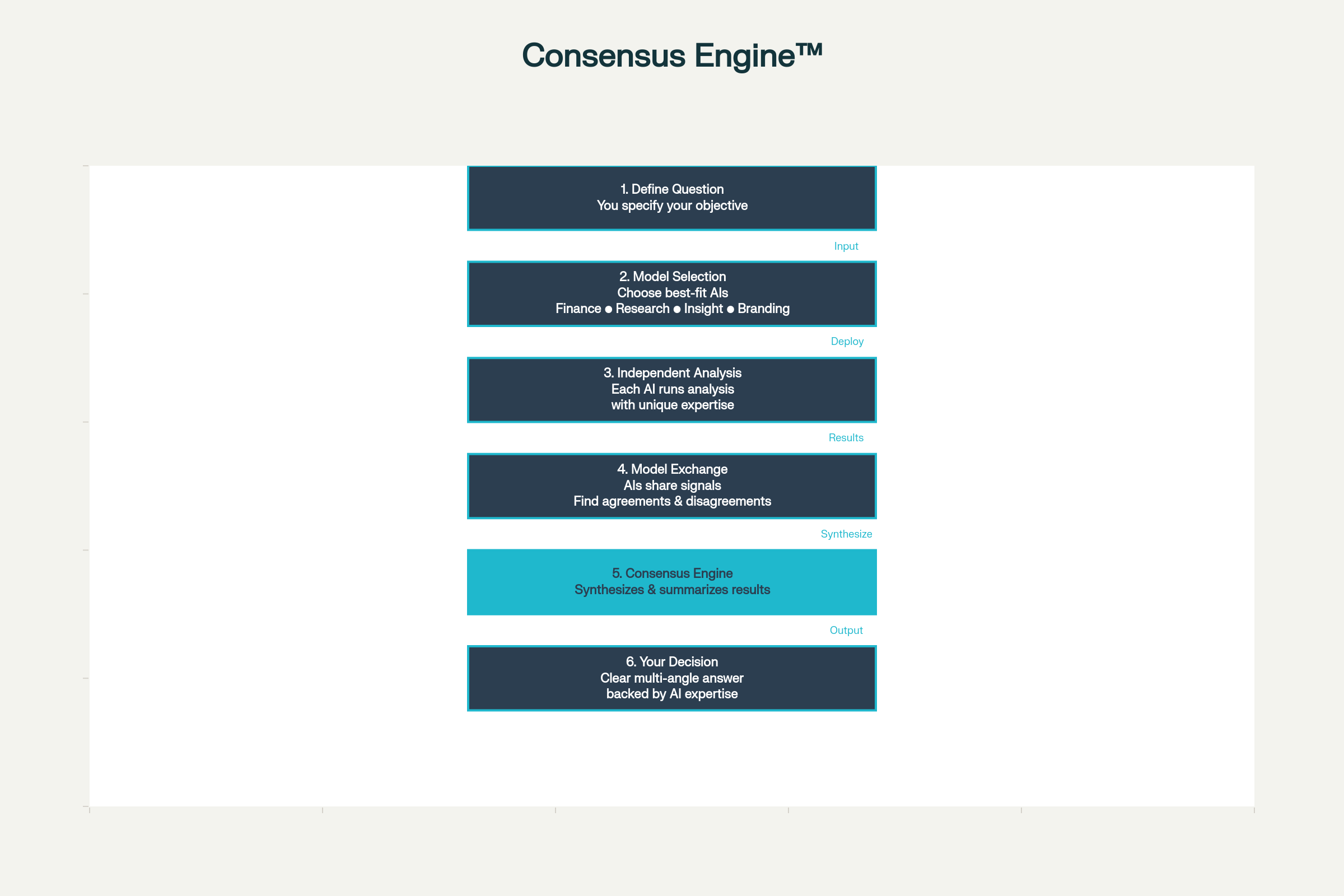
Meet the four fine-tuned researchers that cross-verify 1,000+ sources before you ever see a recommendation.
Got a big question? Get real answers.
Our proprietary AI research platform analyzes 1000+ sources at superhuman speed—SEC filings, patents, medical journals, tax regulations, and more—then delivers one actionable report with citations.
Any business question. Pricing, automation, marketing, compliance-anything.
4 AI agents independently analyze 1000+ sources, then cross-verify findings.
Get one cited, actionable report. Make your call with confidence.
Free With Your Consultation
Every 30-minute consultation includes one free Consensus Engine report
(Normally $79.99 Ask any business question)
30 minutes Zero pressure One free research report
Each run brings these lenses to your question, then synthesizes what they find into one calm, cited brief.
Copy & narrative lens

Finance & numbers lens
Legal, tax, & compliance lens

Future modeling & predictive lens
Under the hood, Consensus Engine walks through your options side by side, shows the evidence each lens leaned on, and explains why the recommended path makes sense. Instead of a single verdict, you get a structured outline of: options, supporting facts, tradeoffs, and a clear "if this, then that" recommendation.
Answered by Upton, founder of Bespoke Ethos.
Because some questions deserve more than a hunch and a single AI answer. I kept running into decisions in my own work where "it depends" wasn't good enough-pricing changes, product kills, market pivots. I didn't want another chatbot; I wanted something that could surround a question from multiple angles, argue with itself a bit, and then hand me a calm, cited brief I could actually act on.
No. A chatbot is built to talk to your customers in real time. Consensus Engine is built to talk to your hardest questions. Under the hood we still use modern models, but the value is in how we frame the question, where we pull evidence from, how we let perspectives disagree, and how we package the output. It's closer to a tiny research desk than anything you'd embed on a website.
Founders and operators who feel the weight of big decisions and don't have a research team on payroll. If you've ever thought, "I wish I had two or three very smart, very honest colleagues to talk this through with," you're the person I built this for. It's not for trivial "what should I post today?" questions-it's for the calls you lose sleep over.
A Bloomberg terminal gives you towering vantage points on markets and instruments if you know how to drive it. Consensus Engine borrows that spirit-a focus on vantage points and receipts-but points it at your specific question instead of a generic feed. You bring the context of your business; the engine brings structured options, tradeoffs, and cited evidence so you're not guessing in the dark.
First, you get citations and reasoning, not a mysterious verdict. You'll see where ideas came from, what each perspective leaned on, and where they disagreed. Second, we start small. Most clients come in with one big question, review the brief together, and decide whether the way we think fits how they want to run the business. You still make the call-Consensus Engine just makes it a lot harder for blind spots to hide.
Yes. I keep one standing grant each year for up to four Consensus Engine research queries. It's reserved for founders and organizations who genuinely need this level of clarity but can't reasonably fit it into the budget right now. There's no fancy application-just email me, tell me what you need my tech for, and if I think we're a fit, we'll make it happen. I know this level of research doesn't come cheap-and I also know it's underpriced for what it can do when you point it at the right questions.

Curious how Consensus Engine™ turns one big question into a calm, cited brief without being a pile of prompts?
Ask for the Consensus Engine™ technical briefGet AI workflow tactics and launch notes directly in your inbox once a month.